Research Output

Publications

Books, journal articles, preprints, presentations, and related press coverage.

Year

Books

Books and Book Chapters

  1. 2026

    Three-Dimensional Electronic-Field Analysis Governing Reaction Selectivity

    Daimon Sakaguchi and Hiroaki Gotoh. In Development of Polymer Materials Using Materials Informatics, Chapter 2, Section 4, pp. 213–225, Technical Information Institute Co., Ltd., July 31, 2026. (Contributed chapter)

    ISBN: 978-4-86798-162-7

Preprints

Preprints

  1. 2026

    Kinetics-Based Framework for Predicting Site- and Facial-Selectivity in Ketone Reductions

    Daimon Sakaguchi, Taisei Kawasaki, Mayu Itakura, Chihiro Tada, Hiroaki Gotoh. ChemRxiv, 2026.

Journal Articles

Peer-Reviewed Papers

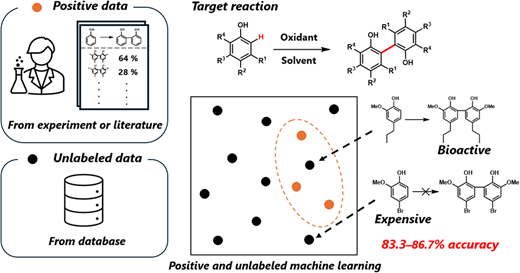
  1. Graphical abstract for machine-learning prediction of phenol oxidative homocoupling reactivity

    2025

    Predicting Substrate Reactivity in Oxidative Homocoupling of Phenols Using Positive and Unlabeled Machine Learning

    Takafumi Nishii, Kaname Ichizawa, Haruka Nagano, Hiroya Mukai, Daimon Sakaguchi, Hiroaki Gotoh. ACS Omega 10(42), 49805–49815, 2025.

    Positive-unlabeled learning predicts oxidative-homocoupling reactivity from known reactions and unlabeled substrates. The study demonstrates a practical machine-learning strategy for experimental datasets in which comprehensive negative examples are difficult to obtain.
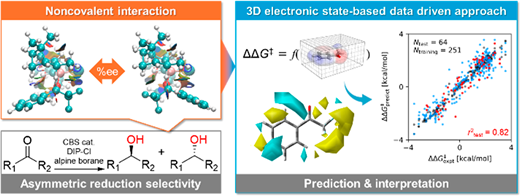
  2. Graphical abstract for the three-dimensional electronic-state analysis of asymmetric ketone reduction

    2025

    Analysis of Asymmetric Reduction of Ketones Using Three-Dimensional Electronic States

    Daimon Sakaguchi, Masaki Shimono, Hiroaki Gotoh. The Journal of Physical Chemistry A 129(39), 8945–8958, 2025.

    Three-dimensional electronic-state fields and data analysis are used to quantify selectivity in asymmetric ketone reduction and identify spatial regions associated with its control. Related descriptor notes
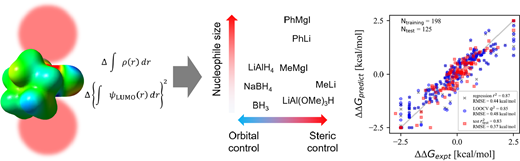
  3. Graphical abstract for predicting facial selectivity in nucleophilic additions to cyclic ketones

    2024

    Using Three-Dimensional Information to Predict and Interpret the Facial Selectivities of Nucleophilic Additions to Cyclic Ketones

    Daimon Sakaguchi, Hiroaki Gotoh. Journal of Chemical Information and Modeling 64(8), 3213–3221, 2024.

    Three-dimensional molecular information and machine learning are combined to predict and interpret facial selectivity in nucleophilic additions to cyclic ketones. Reaction-selectivity foundations

Japanese Article

Highlights and Reports

  1. 2025

    Elucidating the Origin of Facial Selectivity in Nucleophilic Reactions through Quantitative Evaluation of Stereoelectronic States

    Daimon Sakaguchi, Hiroaki Gotoh. Journal of Computer Chemistry, Japan 24(1), A18–A24, 2025. (Japanese)

Presentations

Recent Presentations

  1. Prediction and Interpretation of Reaction Selectivity through Data-Driven Analysis of Noncovalent-Interaction Fields in Transition States
    Daimon Sakaguchi, Masaki Shimono, Hiroaki Gotoh. 2026 Spring Meeting of the Society of Computer Chemistry, Japan, poster 1P05. Program
  2. Extracting Physical-Organic Principles Inherent in Ketone Reduction through Data-Driven Analysis
    Mayu Itakura, Taisei Kawasaki, Tomoki Oishi, Daimon Sakaguchi, Hiroaki Gotoh. SCCJ 2026 Spring Meeting, oral presentation 1O06 (coauthor). Program
  3. Fusion of Transition State Analysis and Data-Driven Approach for Stereoselectivity Prediction in Asymmetric Ketone Reduction
    Gaussian Workshop, poster. Workshop report on Zenn (Japanese)
  4. Fusion of Transition State Analysis and Data-Driven Approach for Stereoselectivity Prediction in Asymmetric Ketone Reduction
    Pacifichem 2025, poster.
  5. Analysis of Asymmetric Reduction of Ketones Using Three-Dimensional Electronic States
    9th Autumn School on Chemoinformatics, poster.
  6. Elucidating the Origins of Chemical Reaction Selectivity through Electronic-State Informatics
    Future Doctoral Festival 2025, poster.

Press

Press and Features

  • Development of a Predictive Model for Chemical Reaction Selectivity through Molecular Electronic-State AnalysisYokohama National University press release, 2024. Link
  • Data-Driven Elucidation of Reaction Selectivity by Integrating Machine Learning and Computational ChemistryChem-Station Spotlight Research, 2024. Link